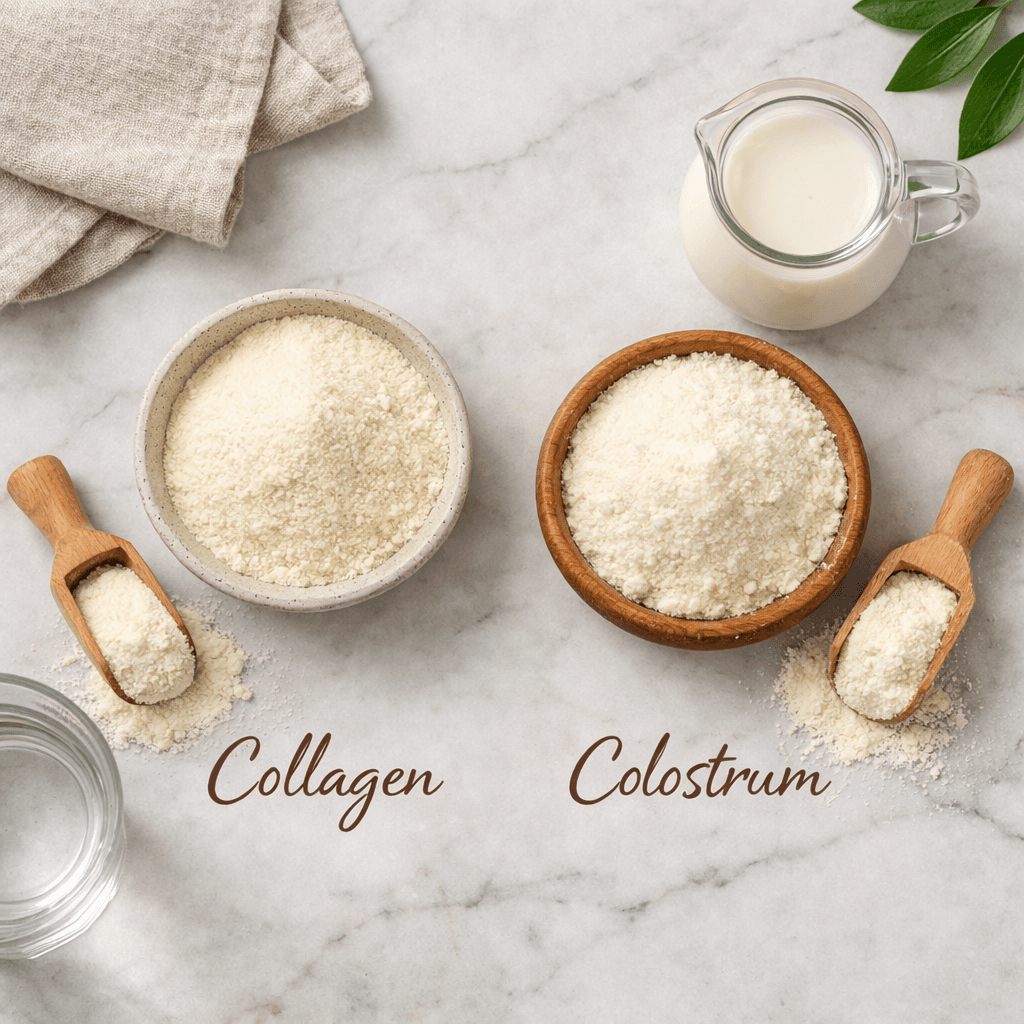
Why Choose Colostrum Over Collagen?
First-milking, never fractionated whole colostrum with 400+ bioactive nutrients — from USDA Grade A grass-fed dairies.
Collagen and colostrum are two of the most talked-about supplements in wellness right now—but they're often confused or lumped together as "the same kind of thing." They're not. While both come from animal sources and both support aspects of health, they work in fundamentally different ways, contain completely different compounds, and serve different purposes in the body.
Understanding the difference can help you decide which one—or both—belongs in your routine.
What Is Collagen?
Collagen is a structural protein—in fact, it's the most abundant protein in the human body, making up roughly 30% of your total protein content. It's the primary building block of your skin, bones, tendons, ligaments, cartilage, and connective tissues. Think of it as the scaffolding that holds your body together.
There are at least 28 types of collagen identified in the human body, but three dominate:
- Type I: Found in skin, bones, tendons, and organs. Makes up about 90% of the body's collagen.
- Type II: Found primarily in cartilage, providing cushioning and flexibility to joints.
- Type III: Found in skin, blood vessels, and internal organs, often alongside Type I.
Your body naturally produces collagen, but production declines with age—roughly 1% per year after your mid-20s. This gradual decline is what drives visible signs of aging like wrinkles, sagging skin, and joint stiffness.
Collagen Supplements
Most collagen supplements contain hydrolyzed collagen (also called collagen peptides)—collagen that has been broken down into smaller peptide chains for easier absorption. These supplements are typically sourced from bovine hide, fish scales, or chicken cartilage and provide the amino acids glycine, proline, and hydroxyproline that your body uses to build its own collagen.
Clinical research supports some benefits. A 2014 study published in Skin Pharmacology and Physiology found that women who took 2.5g of collagen peptides daily for 8 weeks showed statistically significant improvements in skin elasticity compared to placebo. A 2008 study inCurrent Medical Research and Opinion reported that athletes taking 10g of collagen hydrolysate daily for 24 weeks experienced reduced activity-related joint pain.
However, collagen supplements are single-purpose: they provide structural protein building blocks. They don't contain immune factors, growth factors, antimicrobial compounds, or any of the other bioactive molecules that support broader health systems.
What Is Colostrum?
Colostrum is not a single protein—it's a complex whole food. It's the first milk produced by mammals in the initial 24–48 hours after giving birth, and its biological purpose is to jump-start a newborn's immune system, seal the gut lining, and fuel rapid growth. Bovine colostrum—from cows—has been extensively studied for human supplementation because its bioactive compounds are biocompatible with the human body.
Where collagen supplies one type of molecule (structural protein), colostrum delivers over 400 bioactive compounds working in concert. These include:
- Immunoglobulins (IgG, IgA, IgM): Antibodies that support immune defense. Bovine colostrum typically contains 20–25% IgG by dry weight.
- Lactoferrin: An iron-binding glycoprotein with antimicrobial, anti-inflammatory, and antioxidant properties.
- Growth factors (IGF-1, TGF-β, EGF): Signaling molecules that support tissue repair, gut lining integrity, and cellular regeneration.
- Proline-rich polypeptides (PRPs): Immune-modulating peptides that help regulate immune responses.
- Amino acids: Including proline and glycine—the same collagen-building amino acids found in collagen supplements—plus many others.
The Key Difference: Building Blocks vs. Biological Signals
This is the most important distinction between these two supplements:
Collagen: Provides Building Blocks
Collagen supplements give your body the raw amino acid materials (glycine, proline, hydroxyproline) it needs to assemble collagen fibers. It supplies structural ingredients but doesn't direct the body to use them.
Colostrum: Sends Biological Signals
Colostrum contains growth factors like IGF-1 and TGF-β that signal your body's cells to produce collagen, repair tissue, and regenerate. It provides both the raw materials and the instructions.
To use an analogy: collagen is like delivering bricks to a construction site. Colostrum is like delivering bricks and the construction crew, architect, and project manager. The growth factors in colostrum—particularly IGF-1—have been shown to stimulate fibroblast activity, the cells responsible for producing collagen in your skin and connective tissues.
Head-to-Head Comparison
| Feature | Collagen | Colostrum |
|---|---|---|
| What it is | Single structural protein | Complex whole food with 400+ bioactives |
| Primary compounds | Collagen peptides (glycine, proline, hydroxyproline) | Immunoglobulins, lactoferrin, growth factors, PRPs, amino acids |
| How it works | Provides amino acid building blocks | Provides building blocks + growth factor signals |
| Skin support | Supplies collagen precursors | Contains growth factors (IGF-1, EGF) that stimulate collagen production and skin cell renewal |
| Joint support | Provides Type II collagen for cartilage | Contains growth factors (TGF-β) that support cartilage and tissue repair |
| Gut health | Glycine may support gut lining | Growth factors and lactoferrin directly support gut barrier integrity |
| Immune support | None | Immunoglobulins, lactoferrin, and PRPs support immune function |
| Typical serving | 5–15g per day | 3–10g per day |
| Source | Bovine hide, fish scales, chicken cartilage | First-milking bovine colostrum |
Colostrum and Collagen Production
Here's where the relationship between these two supplements gets especially interesting. Colostrum doesn't just contain different compounds than collagen—it may actually support your body's own collagen production through its growth factors.
IGF-1 (Insulin-like Growth Factor 1), naturally present in colostrum, is a key regulator of fibroblast activity. Fibroblasts are the cells in your dermis (the deep layer of skin) that produce collagen, elastin, and other extracellular matrix proteins. Research in the Journal of Clinical Endocrinology & Metabolism has documented IGF-1's role in stimulating collagen synthesis in human fibroblasts.
TGF-β (Transforming Growth Factor-beta), another growth factor abundant in colostrum, is one of the most potent known stimulators of extracellular matrix production—including Type I and Type III collagen. Research published in the Biochemical Journal demonstrated that TGF-β causes sustained increases in the production of Type I and Type III collagen in human dermal fibroblasts.
In other words, while a collagen supplement provides your body with pre-made collagen fragments to absorb and redistribute, colostrum's growth factors may help stimulate your body to produce its own fresh collagen at the cellular level.
An Important Caveat
Most research on IGF-1 and TGF-β stimulating collagen synthesis has examined these growth factors directly (in cell culture or via injection), not specifically through oral colostrum supplementation. While colostrum does contain these growth factors and preliminary evidence is promising, more clinical research is needed to fully quantify the extent of their effect when taken orally. The bioactive compounds in colostrum are bioavailable, but the exact dose-response relationship for collagen stimulation through oral colostrum remains an active area of study.
When to Choose Collagen
Collagen supplements may be the better fit if your primary goals are:
- Targeted skin and beauty support: If your main concern is skin elasticity, wrinkles, or nail strength, collagen peptides have the most direct clinical evidence for these specific outcomes.
- Joint pain from specific activities: Athletes and active individuals with activity-related joint discomfort may benefit from the Type II collagen or hydrolyzed collagen peptides studied for this purpose.
- Simplicity: Collagen is a single, well-understood molecule. If you want a straightforward supplement for structural support, it's a clear choice.
When to Choose Colostrum
Colostrum may be the better fit if you're looking for:
- Multi-system support: Immune function, gut health, recovery, and cellular regeneration—all from a single supplement.
- Gut health and immune function: Colostrum's immunoglobulins, lactoferrin, and growth factors have been studied specifically for gut barrier support and immune modulation. A 1999 study in Gut demonstrated that bovine colostrum prevented NSAID-induced intestinal permeability.
- Recovery and repair: The growth factors in colostrum support tissue repair and recovery at a cellular level—useful for athletes, post-illness recovery, or general wellness.
- A whole-food approach: If you prefer whole-food supplements that deliver a complete nutrient profile rather than isolated compounds, colostrum aligns with that philosophy.
Can You Take Both?
Yes—collagen and colostrum are complementary, not competing. They work through different mechanisms and don't interfere with each other. Taking both means you're providing your body with:
- The raw amino acid building blocks for collagen production (from collagen supplements)
- The growth factor signals that stimulate your cells to actually produce and assemble collagen (from colostrum)
- Immune support, gut health, and recovery benefits that collagen alone doesn't provide (from colostrum)
For people focused on skin health, aging, or beauty-from-within, the combination could be particularly effective—addressing collagen from both the supply side and the production-signaling side. However, if you had to choose one, colostrum offers broader systemic benefits beyond just structural support.
What to Look for in a Colostrum Supplement
Not all colostrum is created equal. The quality and processing method directly affect the bioactive content—especially the growth factors that make colostrum distinct from collagen. Here's what matters:
- Full-spectrum, whole colostrum: Avoid fractionated products that isolate individual components (like IgG-only supplements). Full-spectrum colostrum retains the complete profile of over 400 bioactive compounds working synergistically.
- First-milking sourced: Colostrum collected from the very first milking has the highest concentrations of immunoglobulins and growth factors.
- Low-temperature processing: Heat denatures the delicate growth factors and proteins that give colostrum its unique benefits. Gentle, low-temperature spray drying preserves bioactivity.
- Grass-fed, hormone-free source: USDA Grade A, grass-fed dairies ensure a cleaner, higher-quality product.
TBR Labs Full-Spectrum Colostrum
TBR Labs colostrum is full-spectrum, first-milking, whole colostrum from USDA Grade A grass-fed dairies. It's never fractionated, processed with gentle low-temperature spray drying, and retains all 400+ naturally occurring bioactive nutrients including immunoglobulins, lactoferrin, and growth factors. Available in powder, capsule, and chewable tablet forms.
The Bottom Line
Collagen and colostrum are both valuable supplements, but they're fundamentally different.Collagen is a single structural protein that provides amino acid building blocks for skin, joints, and connective tissue. Colostrum is a complex whole food with 400+ bioactive compounds—including growth factors, immunoglobulins, lactoferrin, and amino acids—that supports immune function, gut health, recovery, and may stimulate your body's own collagen production.
If you're after targeted structural support, collagen has solid clinical evidence. If you want broad-spectrum health support that addresses multiple body systems simultaneously, colostrum is the more comprehensive choice. And if you want the best of both worlds, they can be taken together without conflict.
Medical Disclaimer
The information provided on this website is for educational and informational purposes only and is not intended as medical advice. These statements have not been evaluated by the Food and Drug Administration. Our products are not intended to diagnose, treat, cure, or prevent any disease. Always consult with a qualified healthcare professional before starting any supplement regimen, especially if you are pregnant, nursing, have a medical condition, or are taking medications.
References & Scientific Sources
- Proksch E, et al. "Oral supplementation of specific collagen peptides has beneficial effects on human skin physiology: a double-blind, placebo-controlled study." Skin Pharmacology and Physiology. 2014;27(1):47-55.https://doi.org/10.1159/000351376
- Clark KL, et al. "24-Week study on the use of collagen hydrolysate as a dietary supplement in athletes with activity-related joint pain." Current Medical Research and Opinion. 2008;24(5):1485-1496.https://doi.org/10.1185/030079908X291967
- Playford RJ, et al. "Bovine colostrum is a health food supplement which prevents NSAID induced gut damage." Gut. 1999;44(5):653-658.https://doi.org/10.1136/gut.44.5.653
- Rathe M, et al. "Clinical applications of bovine colostrum therapy: a systematic review."Nutrition Reviews. 2014;72(4):237-254.https://doi.org/10.1111/nure.12089
- Costa A, et al. "Invited review: Bovine colostrum, a promising ingredient for humans and animals—Properties, processing technologies, and uses." Journal of Dairy Science. 2023;106(8):5197-5217.https://doi.org/10.3168/jds.2022-23013
- Campos LD, et al. "Collagen supplementation in skin and orthopedic diseases: A review of the literature." Heliyon. 2023;9(4):e14961.https://doi.org/10.1016/j.heliyon.2023.e14961
- Avila Rodríguez MI, et al. "Collagen: A review on its sources and potential cosmetic applications." Journal of Cosmetic Dermatology. 2018;17(1):20-26.https://doi.org/10.1111/jocd.12450